Saturday, July 14, 2012

A Layman’s Case for Young Doctors


After every crisis that Pakistan comes across, the optimists of this country (and I consider myself part of them) cling on to the hope of the people of this country. Whenever the issue of a failed state crops up, the counter argument is given that, it’s the Government that is failing, not the people. The people will move in the positive direction. However, this current crisis of the young doctors versus the Punjab government has somewhat jolted my belief in the strength of the people. The combination of blunt emotions and amnesia is pushing us in the pit. We have yet to develop the ability to look at an issue in a dispassionate manner.  

In no time the general public has placed the entire blame on the doctors and has labeled them as greedy, unethical, criminals, killers and what not. All this display of emotion is entirely based on the dose of misery that is being dished out by the media for the public appetite. From the entire animated public reaction one could assume that we are such a conscious society that the plight of the poor is the top priority of every living soul. What gets me confused is that where were these poor loving majority, when CM Shahbaz Shariff was distributing laptops like peanuts at the expense of ignoring the  condition of Government schools and primary education? The only reaction I saw then was ‘Laptop Shahbaz da, par vote Imran da’. Here’s your morally upright society for you.  

As far as the media and its ethics are concerned, I am not going to waste time and space by getting into its detail. How balanced a coverage they provide is not a secret. Media gate is not that old even for our collective amnesia prone condition. Even with all this out in the open the media propaganda was successful in portraying the young doctors as the villains. The counter efforts of the doctors through the social media were being labeled as the real propaganda by the people is reflective of our twisted minds. Suddenly, the torture of one of the most educated class is justified and well deserved.    

The question of who is to blame for this chaos and the loss of life still remains. Somehow I have not been able to side with the popular conclusion. The Hippocratic Oath is being referred to time and again in an attempt to remind the young doctors of their duties and how they are violating it. Shouldn’t the government be reminded of the oath that they have taken instead, of looking after the civil right of the people they govern, of providing them with the basic facilities of life and protecting their lives; most of all of proper governance which is missing from the start and the root cause of all the crises including this one as well. The Punjab government does not have a health minister, or a formal documented health policy for that matter is ample proof as to where the fault is, but you don’t say.

Everyone has a right to peaceful protest and the medical community is no exception. They are asking for a proper service structure which is their due. Their strike is not a unique one as a similar case in UK would testify. For all those who have been following the issue from the start would know that these protests turned violent when the state machinery unleashed its wrath and the police started raiding the hospitals as if in search of criminals (which should be noted that they are never able to get a hold on). Closing down the outdoors does not put at risk the lives of the patients as those needing immediate attention are shifted to emergencies. The emergencies and the indoors were operating, until they were raided and the young doctors hunted. How are they expected to be the messiahs under such circumstances and frankly speaking why should they?

Today it is this professional class that is being brutalized, next it could be some other profession as well. It is high time that some collective sense is developed and they be not left alone. To me this seems like a message by the government against demanding our just rights, while they go about unaccountable for whatever they do, from corruption to abusing women MPAs all in the name of democracy. 


Wednesday, May 23, 2012

Khewra Salt Mines


So I got to visit the Khewra Salt Mines (the 2nd largest salt mines in the world), some days back and it was a refreshing experience. PMDC (Pakistan Mineral Development Corporation) deserves the credit for the improvements, making the place quite tourist friendly. (And, Yes! There were tourist, both local and foreigners, so in your face stereotype promoters!)

We owe the discovery of these salt mines to the sick horses of the 326 B.C battle between Alexander the Great and Raja Porous at the bank of river Jhelum, who licked the crop rocks and were cured. Following the horse steps, the humans then made their discovery and these mines got the title of ‘Museum of Geology’ as the rocks exposed here range from pre-Cambrain age to recent times. Before the British took over in 1849, the Janjua Rajas had the ownership here.

One starts to feel the stark difference between the temperatures, right outside the entrance of the mines. The pleasant cold air hits you, and is a big relief compared to the heat outside especially if you are there during this season.

To make things interesting for the visitors, the workers have named different spots inside the mine. If you want you can hire the electric tram that will take you to the ‘Chandni Chowk’, the main spot where different bifurcations of the mines are connected. However, the suggestion is that, if there are no other issues, you should walk there instead of taking the tram, it’s much more fun. You will spot some rare variety of rock salt added loaded with all that extra information that your guide will be happy to share. On your way to ‘Chandni Chowk’, if you are attentive enough, an opening in one of the sides will catch your eye and on a closer look, you will come across 103 constructed steps going up to the Asthma Clinic. Research has showed that, 8 hours in the mines per day for a specific number of days (depending on the patient’s condition), allergic asthma can be treated. For this a health resort has been established here.

The mine workers have built different monuments out of salt bricks and the effect of lights used is amazing. There is a post office, a mosque, a replica of Minar-e-Pakistan and an old canon used to shoot loose salt hangings is preserved in a base of salt bricks. Then there is Nathia Gali, named after one of our mountain resort town, as the salt there is pure white. The last spot in the mines is going to be a small corner where a tree’s root centuries old has been preserved between the mine walls as a fossil and it is the only such fossil there.

By the time you walk out of the mines, you would have had a long walk but there are going to be no signs of tiredness and as your guide will tell you with pride, ‘your respiratory system has been cleansed and you’ll feel the difference at least for a week, before the city’s pollution does the deed’.

Outside you are going to be greeted by goats of every size and color and they know how to play cute. Their presence is going to look odd at first, but then once they start nudging you in the hope of sharing your lunch (their way of demanding their share of tax) you’ll get used to them in no time. In case anyone is wondering, these goats are omnivores! And they like to pose for photographs too.      
         
Amongst the Salt mines lies a worn out Mazar of Syed Sheikh Salman and his wife. By the time the Mazar grabbed our attention it was time to hit the road, so all I could gather from the locals was that in yester years, a lion from the surrounding mountains would come down daily to pay his respects. A tree besides the twin graves was used by the devotees to tie ribbons and strips of cloths for the fulfillments of their Manats (wishes).   

The place holds a lot more history, geology and local lore than what I have mentioned (the entire trip inside the mines is going to last for 2 hours), but I won’t be going into the details here as my basic intention here is to share few of the photographs that I took. 


The surrounding rock mountains

Entrance to the mines, the tram track can be spotted
The electric tram on its way to Chandi Chowk
The guide showing the difference between rocks and salt
Cave walls
Black rock salt
Various salt forms hanging on the roof of the caves
103 stair steps leading to the Asthma Clinic
Salt bricked mosque used by the mine workers for their prayers
An old canon to shoot loose hanging salt
Salt crystal formation
Replica of Minar-e-Pakistan made from salt bricks
A pool of salt water
A cave tunnel, where work is in progress at the other end
Another Salt wall
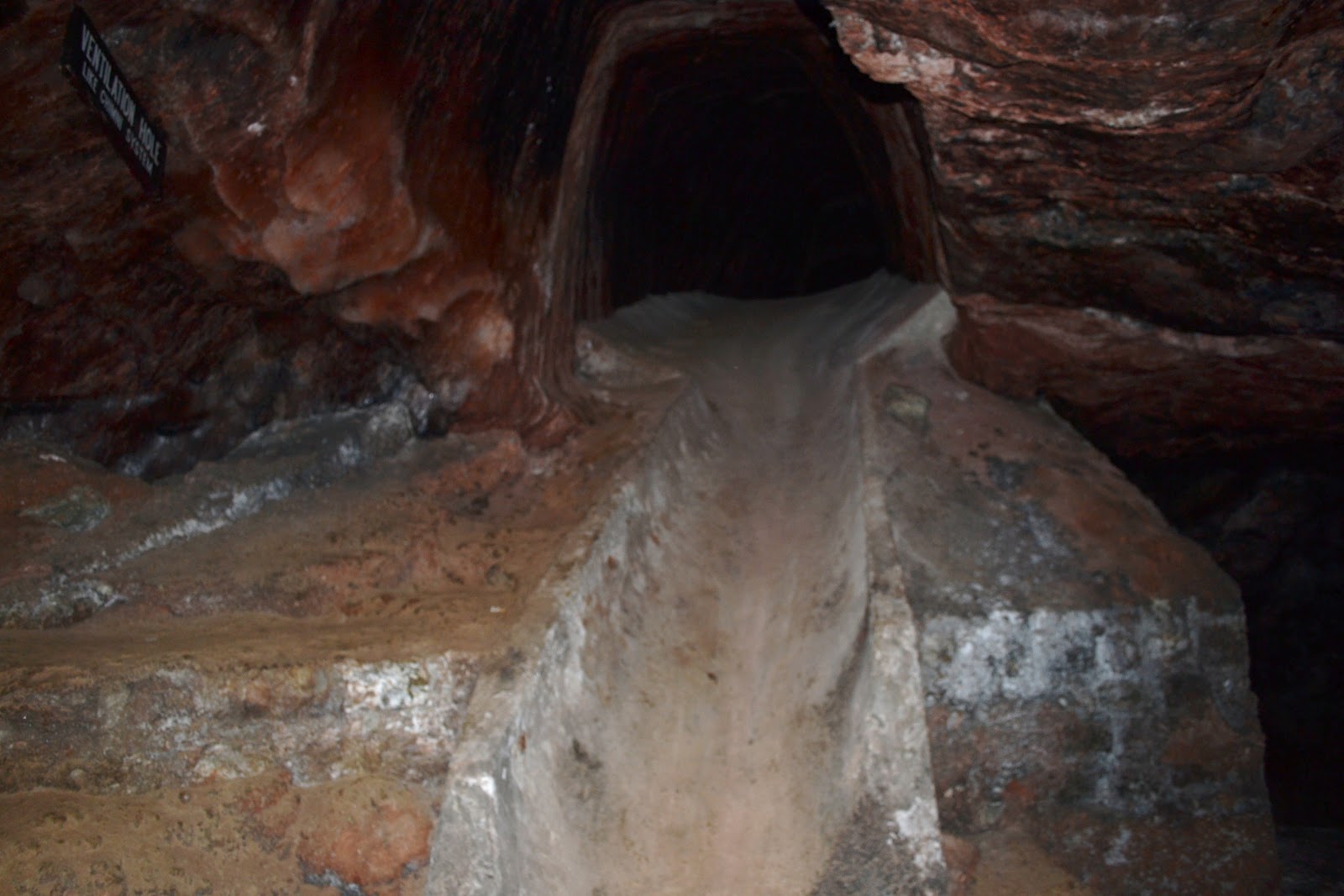
An opening made for the ventilation purposes

Entrance to Nathia Gali
Salt in the Nathia Gali area
Surrounding walls of a salt pool
The other side of the same pool shown in the previous picture
Machinery used for mining work. This tunnel ends in a pool of salt water and the workers reach that spot from here

Roof of a section of the mines

Salt mount's reflection in the water


A section of the mines where, the workers beleive they can see the naturally carved picture of Allama Iqbal 

Three different shades of salt at generated from the same area
The tree fossil
Salt piles besides the path on the way out


The mountain view
The baby omnivore goat (One from the local clan)
    
Outside view of the Shrine of Syed Sheikh Salman

Shrine of Syed Sheikh Salman

A lamp made from salt
Decoration pieces made from salt bought as souvenirs 
Another variety of the salt lamps

An old construction outside the mines, once used as horse stable


Sunday, March 11, 2012

Tuesday, February 7, 2012

The Wrong Kind of Branding


Branding is only successful, when it is done in the write context. Therefore, using the right brand ambassador falls in the same line. It is no surprise that in a country known for its passion for cricket, brands use the players as their star attraction. Among all the players of Pakistan’s team Shahid Afridi aka Lala is a league in himself and a lot of brands use him.

P&G did a sloppy job with their new Head & Shoulders commercial.


The main theme of the ad is that Afridi cools down after using Head & Shoulders when he is not able to concentrate, then he blocks a ball & everyone goes ‘Cool Cool Afridi’. The mismatch here is that Afridi’s star power is not because of the cool cool factor. It is the complete opposite of it. He is known for hitting around the ball which at times gets him out on a duck, but then that is the Lala brand for you.
If this was not bad enough, the radio version is worse. The whole idea of Afridi washing up during the drinks break is absurd, to say the least!!! 

Sunday, February 5, 2012

Waste Land – The Effect of the Human Side


Waste Land was in my ‘to watch’ list along with a number of titles that I have now decided to dig in before the list gets too long. Now from my ‘to watch’ list, it has shifted to my ‘favorite’ list.

The film is based on the journey of the renowned Brazilian artist Vik Muniz back to his home land Brazil & Jardim Gramacho, world’s largest garbage dump. Muniz’s initial idea was to paint the garbage pictures but after interacting with them, he came up with something better. He involved the pickers in his project by making them work on their own pictures with recyclable garbage. To quote Vik ‘..so that they can say we did it, not that Vik did it.’ Taking their pictures in natural & semi-natural environments, he then guided them to recreating them with the material that they collected from the dump. In the end those pictures get a top ranking exhibition & the funds help transform the life of some of the pickers.

It is the human factor that touches you the most, or at least that is what impacted me the most. The horror of the mountains of the garbage was taken over by the stories of the people involved & their struggle & aspirations.

Generally, we make assumptions about people based on our perceptions about them as per their outlook. Nobody bothers to look deeper than the outlook, where the true story lies. As the saying goes ‘appearances are deceptive’. These people who are disregarded as lesser beings have ideas & philosophy of life that can put the socially accepted intellectuals to shame. Some examples from the film include; Valter who argued with people that 99 is not 100. Tiao Santos, who worked for organizing the community of the pickers, to ensure that they can put their demands in front of the authorities & how he kept going when even people who he wanted to help, did not believe in him. Then there was another individual, who would pick books while looking for recyclable stuff & bring it to the community’s centre & intended to build a community library. He would be shocked to see that people throw away books in their garbage. The women in the group were proud of the fact that they were earning their living through hard work & not begging or prostitution. These are just few of the examples.


This is one side of the human aspect that touches you; the other is the one that is reflected by Vik Muniz. People, who when they get their goals give back to their community & not be ashamed of their roots are not in the majority around us. To realize that it was a combination of their work & luck that got them where they are. Like Vik states that a lot of these pickers are from lower middle class families & they ended up there because drastic circumstances evolved around them & they had to be there for their survival. Had something similar happened to him, he could have ended up there as well. Near the end of the film Vik says that when you don’t have anything, you desire material things & when you have everything you don’t desire any material gains. For himself he admitted that ‘I had to buy a lot of crap before I could get over my complex’. This view is not shared by a lot of people. A lot of people cannot get over their complex & in some cases it gets destructive, both for themselves & others around them. In my opinion, those who will watch this documentary, (& I highly recommend that everyone does) he will be a source of inspiration.

There is a part where Vik & other collaborators of the project are discussing the long term effects on the pickers at the close of their project, as a lot of them said that they didn’t want to go back. The option of flying them to London was under discussing. One opinion came that people are fragile & once they get to see the other side, reconciling with their original status would have devastating effect on them. The counter argument was that if they don’t get to see the other side, how will they work towards getting out of their present situation. I personally agree to this view point. While this is a reality of life that not everyone will get the same status or rewards for their input, this is no reason for not giving everyone a chance to try. Hampering this chance for others should not be allowed. Everyone is entitled to the basics & then let the nature course take its route. This is a kind of mind set that we have towards education in our own country which has led to an education crisis.

If nothing else, the viewers will take home the idea of giving back to your community & the realization that in search of doing something big, we lose out on the opportunities to make a significant difference in a few peoples’ lives, which can trigger the much needed trickledown effect.             


Wednesday, January 25, 2012

The Punjab Assembly does it yet again


The Punjab Assembly has passed a resolution banningconcerts in institutions. During the debate they added the word ‘objectionable’ to the resolution. However, no one was bothered to define the term objectionable. So with a lot of crazy things going around in our country, the PA has given one more front to the nut cases (& we have a lot of them) to use as an excuse for doing as they please. 

Suffocating the people is what seems to be the objective of this assembly & the irony is that they are paid for it by the tax payers’ money. No matter how much we want to forget the horrors of the Zia era, they keep coming back in one form or the other. Like always, they used religion to back their mindless ideas. I wonder why they don’t find anything mentioned in Islam, about liars, hoarders, hierocracy, rapist, poverty etc, real issues of the people, so that they can pass laws for them too. Not that these issues are not mentioned in the religion, they are but they choose to ignore them as they will be at the receiving end then.

This is the same assembly that was discussing polygamy & trying to justify it. The same day I met a school kid whose tuition fee was due & he was out on the road trying to sell stationary to be able to raise the money. Another gem that is credited to the PA, is the lota foot ballmatch that the members performed in the grounds of the premises.

The fact that the issues of the people are never discussed in the assembly, drain out hope for democracy. Institutions need time to establish themselves, but when people responsible for them don’t show that they mean serious business, their survival is at stake. This is especially true for a country like Pakistan, where a large majority is deprived of the basic needs of their lives.


p.s Zoo & the Punjab Assembly are located in the same area, merging them won't be that bad an idea, keeping in mind the direction in which the PA is headed.

Monday, January 16, 2012

Pakistan - India Relaxed Visa Policy


In this globalized world, it is quite easy to communicate with anyone around the planet. One can travel other countries in hours as compared to days & months. The case of Pakistan & India is different. Two neighboring countries, whose citizens can’t visit each other with ease. The visa process is hell & one of the most difficult one. A difficulty, which is solely reserved for each other. No wonder then that SAARC is a failed organization & has done nothing substantial for the region. How can it succeed when both the main players have a trust deficit which no one is interested in improving? Not that the situation can’t be approved, after all France & Germany were able to do it.


In an effort to improve the Indo-Pak visa policy & highlight its benefits, Institute of Peace & Secular Studies (IPSS) arranged a conference on the 14th of January. Dr. Khalid Zaheer was one of the speakers, who spoke on the topic ‘How will a relaxed policy help attain peace?’ By the time I reached the venue his session was already in the Q & A phase. In answering one of the questions he said that the reason for the success of the negative forces is that they are very much committed to their cause, which we in the majority believe to be wrong. Those of us who are in the majority are not committed to the cause in which believe in, thus, tilting the balance in their favour.

Rtd. Professor Nabeela Kyani of Government College Univerity, narrated a story titled ‘An Ink Bottle’. The story revolved around an old man, who had witnessed partition of subcontinent. He left his belongings in the custody of his Hindu friend. When things settle down & they start waiting for the stuff, the delay causes his family to believe that they will never see their things again. The old man however, sticks to his belief that his friend is a good & trustworthy person. Meanwhile he falls in love with a University professor & takes his mother to her place, who rejects the proposal because the girl is Christian. In the end a truck does deliver their stuff along with a handwritten list, which even had the empty ink bottle listed & returned.